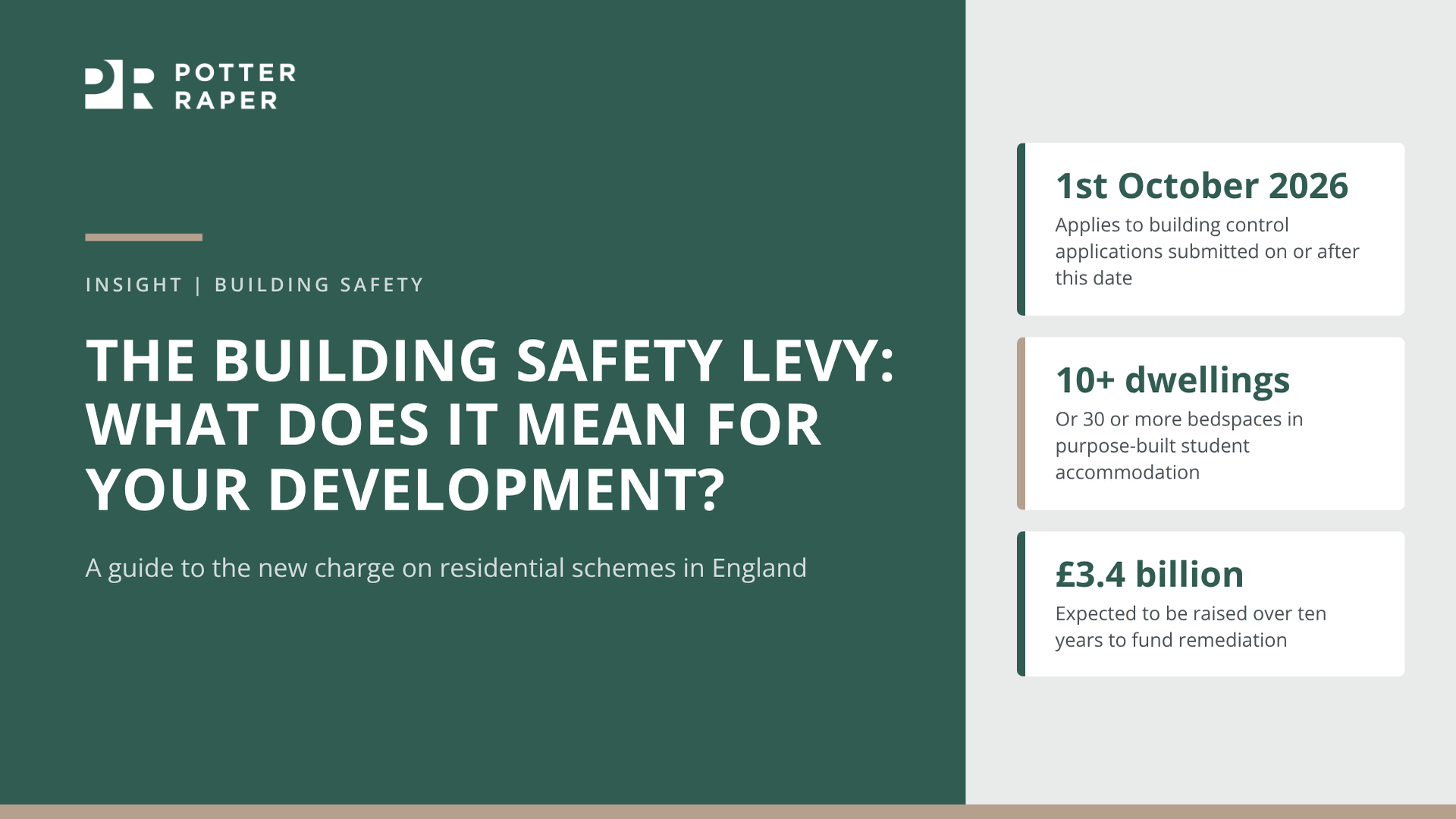
Since 1st October 2026, most new residential developments in England have been liable for the Building Safety Levy, a charge on floorspace that developers must pay before a completion certificate can be issued. The levy was introduced under the Building Safety Act 2022 and is implemented through the Building Safety Levy (England) Regulations 2025.
The purpose of the levy is to fund the remediation of historic building safety defects in residential buildings, including unsafe cladding, so that the cost of making existing buildings safe is met by the development industry rather than by leaseholders or taxpayers. The government expects the levy to raise approximately £3.4 billion over ten years.
For developers and their consultants, the levy introduces a new cost that needs to be identified at the appraisal stage, together with additional requirements within the building control process. This article explains which schemes are affected and how the levy is calculated and collected, before considering what it means for the way in which residential schemes are appraised and cost planned.
______________________________________________________________________________________________________________________________________________________________
Which developments are affected?
The levy applies to building control applications and initial notices submitted on or after 1st October 2026 for developments that provide 10 or more net additional dwellings, or 30 or more net additional bedspaces in purpose-built student accommodation. Developments created through a change of use to residential use are included. Applications submitted before 1st October 2026 are not liable, even where they are amended at a later date.
The levy applies whichever building control route is used. This includes full plans applications made to a local authority, initial notices given through a Registered Building Control Approver and applications made to the Building Safety Regulator for higher-risk buildings. In each case, the local authority acts as the collecting authority.
Developers should be aware that authorities will look at the number of new dwellings permitted by the planning permission rather than the number included in each building control submission. A scheme that is divided into several smaller submissions will therefore still be liable where the planning permission as a whole exceeds the threshold.
______________________________________________________________________________________________________________________________________________________________
Exemptions
Affordable housing, supported housing and housing built by non-profit registered providers or their wholly owned subsidiaries are exempt from the levy. Schedule 1 of the regulations sets out a further list of building types that are exempt, and developers should check the government guidance where a scheme includes a mix of tenures or uses, as the exemption may apply to only part of the development.
______________________________________________________________________________________________________________________________________________________________
How is the levy calculated?
The levy is charged per square metre of residential floorspace, including the communal areas that serve the dwellings. The rates are set nationally in the legislation and differ between local authority areas.
Developments on previously developed land receive a 50% discount on the applicable rate, provided that at least 75% of the consented site qualifies as previously developed land. Amending regulations laid in July 2026 changed the types of land that can benefit from the discounted rate, so developers of brownfield sites should confirm their eligibility against the current version of the regulations.
______________________________________________________________________________________________________________________________________________________________
How is the levy collected?
Levy information must now be included with every relevant building control application or initial notice, and an application that does not include the required information may be rejected. Further information for the calculation of the levy is collected at the commencement notice stage. Where a Registered Building Control Approver is overseeing the work, the client must send a copy of the commencement notice, the levy information and the supporting evidence to the collecting authority within two working days.
Once the authority has the information it needs, it issues either a Levy Liability Notice confirming the amount payable or a Notice of No Charge. When the levy has been paid in full, the authority issues a Levy Payment Certificate. Developers can request a review of the levy charge within 28 days if they wish to dispute it.
The consequence of non-payment is significant. If the levy has not been paid, the local authority will withhold the completion certificate or reject any final certificate issued by a Registered Building Control Approver.
______________________________________________________________________________________________________________________________________________________________
What does this mean for residential developers?
The levy should be included as a separate item in development appraisals and cost plans from the earliest feasibility stage. As the charge is calculated on floorspace, the allowance will change as the design develops, and the cost plan should be updated at each stage so that the levy reflects the current area schedule rather than an early estimate.
For schemes on brownfield land, the eligibility for the previously developed land discount should be established as early as possible, since the discount halves the rate and can have a material effect on viability. The same applies to mixed-tenure schemes, where the extent of any exemption for affordable or supported housing will determine the chargeable area.
The timing of the payment also needs to be considered. The levy falls due before completion or occupation, so it should be included in the cash flow forecast for the project, and the programme for handover should allow time for the payment to be made and the payment certificate to be issued. A delay at this stage could hold up the completion certificate and, in turn, the occupation of the building.
Finally, schemes that were appraised or acquired before the levy was introduced may not include an allowance for it. Where the building control application for such a scheme has not yet been submitted, the appraisal should be reviewed to confirm that the scheme remains viable once the levy is included.
______________________________________________________________________________________________________________________________________________________________
How Potter Raper can help
Potter Raper’s Quantity Surveying teams prepare cost plans and development appraisals for residential schemes across London and the South East and East of England, and can advise clients on the likely levy liability for their schemes and how the charge should be reflected in their development appraisals, cost plans and cash flow forecasts.
To discuss how the Building Safety Levy affects your development, please contact our Quantity Surveying team.